

















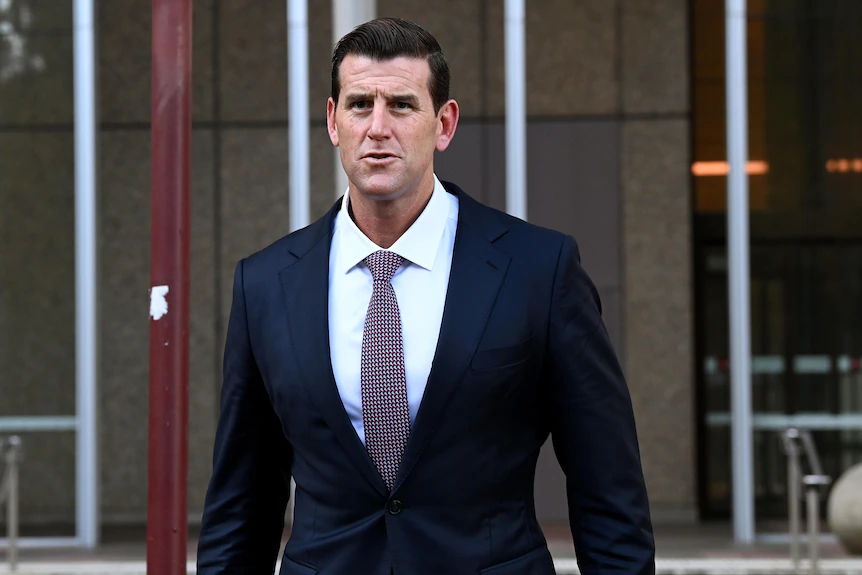

Ben Roberts-Smith was a courageous soldier who sought neither decorations nor fame, yet had an objective put on his back by his Victoria Cross, and his standing destroyed by jealous comrades, helped by credulous journalists, his lawyers have told the government court in Sydney.
Closing submissions have begun in Roberts-Smith’s long-running defamation trial against three newspapers over reports he alleges defame him as a war criminal and murderer. He denies any wrongdoing.
The newspapers are defending their reporting as evident, including charges Roberts-Smith carried out six murders while sent to Afghanistan as an member from the SAS, was a bully and a perpetrator of domestic violence.
Roberts-Smith’s advocate, Arthur Moses SC, said the newspaper reports depended on “rumor, hearsay and contradictory accounts”. He said the journalists who thought of them were “all too willing to write sensationalist accounts” and had mounted a deliberate campaign to unfairly malign Roberts-Smith.
“Mr Roberts-Smith was an uncommon soldier; profoundly coordinated, trained, a leader, resourceful and extraordinarily brave,” Moses told the court on Monday morning.
“He didn’t look for, nor did he need any acknowledgment for playing out his duties as an member from the Australian Defense Force. What he didn’t expect is, having been granted the Victoria Cross, he would have a target on his back.”
Moses told the court the defamation trial had been designated “a large number of things”, including the “trial of the century”, a “proxy war crimes trial” and an “attack on the freedom of the press”.
“It is none of these,” Moses said.
“This has been a case about how Mr Roberts-Smith, the most brightened Australian soldier, and a man with a high standing for boldness, expertise and decency in soldiering, had that standing obliterated by the respondents.”
Matthew Richardson SC, likewise showing up for Roberts-Smith, told the court the impartial idea of the judicial procedures “omit the reality this case is about a person … who has endured, who was once known as a hero, and who is presently, because of the respondents, broadly criticized as a killer and a victimizer of ladies”.
Nicholas Owens SC, representing the three papers – the Age, the Sydney Morning Herald, and the Canberra Times – managed the charges Roberts-Smith had been engaged with the homicides of two men found concealing in a tunnel at a compound called Whiskey 108, in the village of Kakarak in southern Afghanistan in 2009.
The newspapers charge the two men were unlawfully killed: one, an older man, was purportedly killed by an unpracticed Australian SAS soldier on the orders of his superior, in a “blooding” occurrence; the second, who had a prosthetic leg, was supposedly “frog-marched” outside the compound, tossed to the ground and machine-gunned to death by Roberts-Smith.
Owens said the court had heard numerous records from soldiers on the ground at Whiskey 108 who gave “unchallenged proof” that two men were pulled out of the passage. Other warrior observes affirmed they saw Roberts-Smith shoot dead the man with the prosthetic leg, while others have given proof they saw Roberts-Smith requesting the execution of the old man.
Roberts-Smith has reliably kept up with “no one emerged from the tunnel” and said the two men killed were legitimate insurgent targets. Roberts-Smith said he shot the man with a prosthetic leg, who was outfitted with a weapon and running external the compound, while the older man was shot by another soldier whose personality he doesn’t know.
Owens said the proof from a portion of the soldiers called by Roberts-Smith to help his form of occasions had been totally repudiated by Roberts-Smith since it was not sound.
“In any case, one can’t simply imagine that an observer’s proof didn’t occur,” Owens told the court.
Owens said those summoned by the newspapers to give proof were “genuine men”, and their declaration was “exact”. He said Roberts-Smith’s observers, paradoxically, were compromised: “Every one of those witnesses had a conspicuous intention to lie.”
“There is certainly not a solitary observer that Roberts-Smith brought comparable to Whiskey 108 who couldn’t be depicted as a nearby close friend.
“Person 5 [Roberts-Smith’s patrol commander on the mission] has the extra rationale to lie since he, at the end of the day, stands denounced.”
Owens expressed proof from a warrior anonymised as Person 38, called by Roberts-Smith and who gave proof about “clearing” a plantation close to the compound that was not upheld by some other declaration, was “outright dishonest” or “hopelessly compromised”.
Owens told the court “your honor is faced with a predicament, that somebody is lying”.
Legal counselors for Roberts-Smith have not named a figure for harms and irritated harms looked for.
The expense of running the trial – which has heard over 100 days of proof with witnesses summoned to affirm from everywhere the world – has been assessed at $25m.
Shutting entries are scheduled to run to the middle of the following week. A judgment from Justice Besanko is probable a while away.