








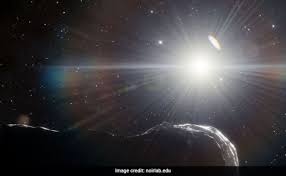

Washington: A global group of stargazers on Monday reported the disclosure of an enormous space rock whose circle crosses that of Earth, making a little opportunity far in store for a devastating crash.
The 1.5 kilometer-(0.9 mile-) wide space rock, named 2022 AP7, was found in region famously challenging to recognize objects because of the brightness from the Sun.
It was found alongside two other close Earth space rocks utilizing a cutting edge instrument on the Victor M. Blanco telescope in Chile that was initially evolved to concentrate on dull matter.
“2022 AP7 crosses Earth’s circle, which makes it a possibly unsafe space rock, yet it as of now doesn’t currently or whenever in the future have a direction that will have it crash into the Earth,” said lead creator of the discoveries, stargazer Scott Sheppard of the Carnegie Foundation for Science.
The potential danger comes from the way that like any circling object, its direction will be gradually changed because of bunch gravitational powers, prominently via planets. Conjectures are thusly troublesome on the extremely long haul.
The newfound space rock is “the biggest item that is possibly risky to Earth to be found over the most recent eight years,” said NOIRLab, a US-financed research bunch that works different observatories.
2022 AP7 requires five years to circle the Sun under its ongoing circle, which at its nearest highlight Earth stay a few million kilometers away.
The gamble is thusly tiny, yet in the event of a crash, a space rock of that size “would devastatingly affect life as far as we might be concerned,” said Sheppard. He made sense of that residue sent off up high would have a significant cooling impact, inciting an “elimination occasion like hasn’t been seen on Earth in huge number of years.”
His group’s outcomes were distributed in the logical diary The Galactic Diary. The two different space rocks represent no gamble to Earth, yet one is the nearest space rock to the Sun at any point found.
Exactly 30,000 space rocks of all sizes – – including more than 850 bigger than a kilometer wide – – have been recorded nearby the Earth, procuring them the name “Close to Earth Items” (NEOs). Not a single one of them undermine Earth for the following 100 years.
As per Sheppard, there are “probable 20 to 50 enormous NEOs left to find,” however most are on circles that put them in the Sun’s brightness.
In anticipation of a future disclosure of a seriously compromising article, NASA led a test mission in late September in which it impacted a rocket with a space rock, demonstrating that shifting its direction was conceivable.