








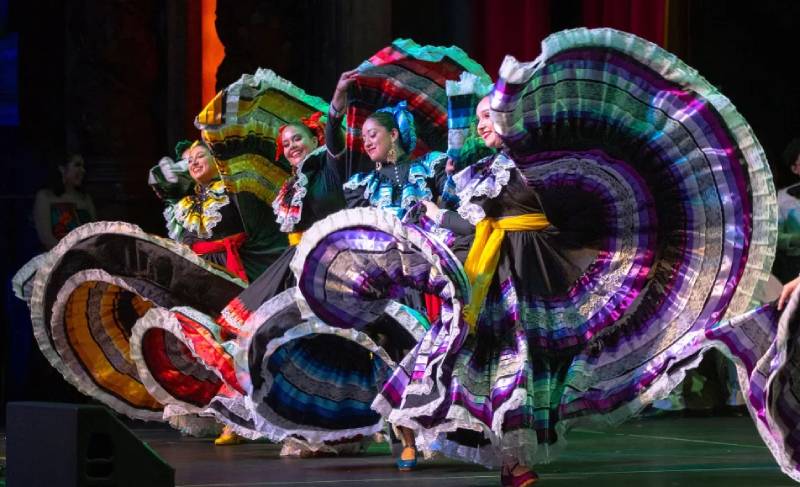

Artists across the city associated and exhibited their Latino roots at the debut Chicago Latino Dance Celebration (CLDF) last month, facilitated by the Worldwide Latino Social Focal point of Chicago (ILCC).
The celebration was hung on Sept. 30 in various areas, one of which was Humboldt Park, and included 37 dance bunches with associations with 16 distinct Latin American nations.
The ILCC is a container latino multidisciplinary association that has various occasions, including the Chicago Latino Film Celebration. Mateo Mulcahy, the delegate chief overseer of ILLC said that they started arranging the dance celebration after he saw there could have been no other dance celebration in the city that gave a “exhaustive” perspective on every one of the Latino societies and their moves.
“Over the last couple of years, we have made a concerted effort to diversify our programming,” Mulcahy said. “We have done a lot of music, dance, theater and comedy, but we wrapped it up significantly.”
The different sorts of Latino moves displayed at the celebration included customary and folkloric, current and other well known moves like salsa, merengue, bachata, samba and tango. Practically every one of the moves were arranged by Latinos, a deliberate move by Mulcahy who, “needed to ensure we were including our whole Latino dance local area.”
Pepe Vargas, the leader chief and pioneer behind the social place, said that when he was working close by Mulcahy, his vision was for the occasion to “join us.”
“The great differences we see among ourselves is in the richness of our cultures,” Vargas said. “We discover that with music, with film, with poetry, with dance. There is so much difference even within each country.”
Individuals from the Laruni Hati Garifuna Dance Gathering were among the people who shared their way of life when they took on the “Subelo!” stage at the Worldwide Harmony Cookout last month.
The dance bunch was framed in 2010, comprising of a variety of drummers, vocalists and artists who have practical experience in a few social moves, said Fidelis Huestes, an individual from the dance bunch.
Hunguhungu, an influencing dance, was one of the moves the gathering exhibited at the celebration. They additionally included Punta, the most famous dance, as per bunch individuals; Chumba, which is like salsa; what’s more, a mix dance, which is a combination of Hunguhungu and Punta.
Hati has performed at a few occasions in the Chicagoland region pre-pandemic and rejoined for the celebration, Huestes said. Most of their moves are Belizean-American however have establishes in Honduras and Guatemala.
Huestes said she was eager to partake in the celebration, and shared the meaning of the Laruni Hati Garifuna Dance Gathering’s association.
“It was a showcasing of our culture and to let people know that Belize is part of Latin America and that it’s the only english speaking country in Latin America. Also showcasing that there are different cultures in Belize itself…I’m totally excited and I know other people are excited to see us on stage… We want to make sure that the city of Chicago knows we are still here and that we exist,” said Huestes.
The Focal point of Peruvian Expressions’ dance bunch additionally partook in the celebration.
Rubén Pachas, the head of the Focal point of Peruvian Expressions, and his better half and prime supporter, Jessica Loyaga, have been showing Peruvian dance to understudies in the Chicago Government funded Educational system. Their objective has been to advance Peruvian culture since they moved from Peru in 2005, they said.
The two Pachas and Loyaga are expressions educators and were working in state funded schooling for quite a long time in Peru. At the point when they arrived in Chicago, they started showing in CPS. They then opened their dance association, Pachas said.
Pachas and his better half framed the dance bunch with their current and previous understudies. The dance bunch offered Pachas the chance to show youngsters of different ages and identities about Peruvian culture through dance, he said.
“The group has the characteristic of being a group of indigenous, pre-Hispanic dances, but we also perform colonial and post-colonial dances, which encompass all the republican-era dances,” Pachas said in Spanish.
Through this dance gathering, Pachas and his better half teach their understudies, yet in addition assist them with building their certainty.
“That’s what dance does. It gives you self-assurance and boosts your self-esteem,” said Pachas. “It shows you that you can do anything, not just dance but many things. That makes me feel happy… that’s what dance has done for me. When I was young, I learned many values from indigenous cultures, and that’s why I became interested in promoting them.”
Pachas said he has had the chance to watch his understudies develop their certainty while showing them customary native moves from Peru. At the point when he was a kid, Pachas voyaged and lived with native networks in Peru and had the option to gain these moves from them.
Sharing these qualities assists Pachas with keeping customs from native societies alive among more youthful ages.
“That’s what I taught in Lima, Peru, and that’s what we’ve taught here in the schools… that’s how indigenous cultures learned, through the transmission of values, the transmission of knowledge,” Pachas said. “That’s what we do, we transmit this through practices, knowledge, and they pick it up, develop it, and adapt it to their lives.”
The social community arranged four dates to have the celebration in various neighborhoods across Chicago, Mulcahy said.
The celebration started at the Old Town School of People Music on the North Side. It later extended to the Logan Place for Human expressions on the South Side, and the latest occasion was held at the Worldwide Harmony Cookout in Humboldt Park on the Northwest Side. Their most recent occasion will be held at the Segundo Ruiz Belvis Social Center at 4046 W. Armitage St. on Oct. 12.