


















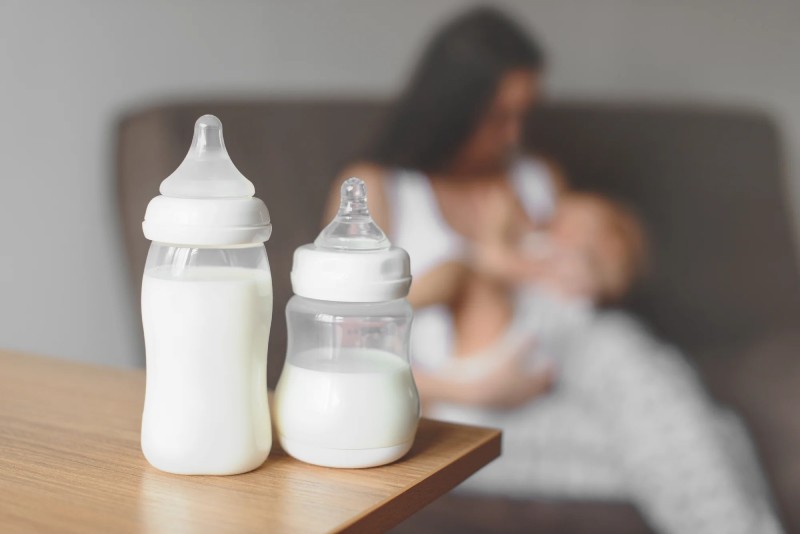

Another concentrate by researchers at the Jean Mayer USDA Human Nourishment Exploration Center on Maturing (HNRCA) at Tufts College proposes that a micronutrient in human bosom milk gives critical advantage to the creating cerebrums of babies, a finding that further enlightens the connection among sustenance and mind wellbeing and could assist with further developing baby equations utilized in conditions while breastfeeding is preposterous.
The study, which was published on July 11 in the Proceedings of the National Academy of Sciences (PNAS), also paves the way for future research into the potential function of this micronutrient in aging brains.
Scientists found that the micronutrient, a sugar particle called myo-inositol, was most noticeable in human bosom milk during the main long stretches of lactation, when neuronal associations named neurotransmitters are framing quickly in the baby mind. This was valid no matter what the mother’s nationality or foundation; the specialists profiled and analyzed human milk tests gathered across locales in Mexico City, Shanghai, and Cincinnati by the Worldwide Investigation of Human Milk review, which included solid moms of term singleton babies.
Myo-inositol increased the size and number of synaptic connections between neurons in the developing brain, indicating stronger connectivity, according to subsequent testing with human neurons and rodent models.
According to Thomas Biederer, senior scientist on the Neuroscience and Aging Team at the HNRCA, senior author of the study, and faculty member at the Yale School of Medicine, where he leads a research group in the Department of Neurology, “Forming and refining brain connectivity from birth is guided by genetic and environmental forces as well as by human experiences.”
Diet is one of the many environmental factors that can be studied. In early earliest stages, the mind might be especially delicate to dietary variables in light of the fact that the blood-cerebrum hindrance is more penetrable, and little particles taken in as food can all the more effectively pass from the blood to the cerebrum.
According to Biederer, “as a neuroscientist, it’s fascinating to me how profound the effects of micronutrients are on the brain.” Human breast milk is amazing for its complexity and richness, and I now believe that its composition is dynamically changing to support various stages of infant brain development.”
He observes that women in very different geographical locations have similar levels of myo-inositol, indicating that it plays a generally important role in the development of the human brain.
Other studies have shown that as babies grow and develop, inositol levels in the brain decrease over time. In grown-ups, lower than ordinary mind inositol levels have been tracked down in patients with significant burdensome problems and bipolar illness. Hereditary modifications in myo-inositol carriers have been connected to schizophrenia. Myo-inositol accumulations have been found to be higher than normal in Down’s syndrome patients and Alzheimer’s disease patients with Down’s syndrome.
“The momentum research shows that for conditions where breastfeeding is unimaginable, it could be advantageous to build the degrees of myo-inositol in baby recipe,” Biederer says.
However, Biederer states that it is too early to suggest that adults consume more myo-inositol, which can be found in significant quantities in a variety of grains, beans, bran, citrus fruits, and cantaloupe (but not in such high quantities in cow’s milk). We don’t have the foggiest idea why inositol levels are lower in grown-ups with specific mental circumstances, or higher in those with specific different sicknesses,” he says.
There are still a lot of research questions: Is depression and bipolar disorder caused by lower levels of inositol or a side effect of medications used to treat them? Do people with Down syndrome and Alzheimer’s disease have levels of myo-inositol that are higher than normal? At various ages, what is the “right” amount of myo-inositol in the brain for optimal brain health?
According to Biederer, “my colleagues at the HNRCA and I are currently pursuing research to test how micronutrients like myo-inositol may impact cells and connectivity in the aging brain.” We trust this work prompts a superior comprehension of how dietary elements interaction with age-related mind variations.”
Reckitt Benckiser / Mead Johnson Nutrition and a donation from the Robert and Margaret Patricelli Family Foundation supported this work. The published paper provides comprehensive information regarding authors, funders, methodology, and conflicts of interest.