









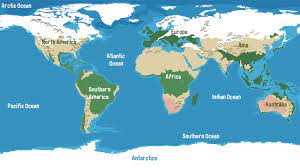

More than 70% of our world is covered by water, and the oceans hold 96.5% of that water. Or perhaps it should be oceans? As it turns out, scientists disagree on the precise number of oceans on Earth.
According to the National Oceanic and Atmospheric Administration (NOAA), there is only one ocean in the world technically since the marine ecosystem is interconnected in some way.
The Atlantic, Pacific, Indian, and Arctic Oceans are the four physically distinct ocean basins.
Despite there being disagreement about its official definition, oceans are the largest bodies of water on earth. Because it has not yet obtained complete agreements from its members, the International Hydrographic Organisation, which is made up of 98 member states and is in charge of drawing the boundaries of the oceans, has not yet recognised the Southern Ocean.
“We really like to think about things as being the global ocean, but it’s particularly helpful to think about different regions and talk about more regional problems,” she said to Live Science. People tend to focus on local issues and find it difficult to comprehend some of the major ocean difficulties that are global in scope.