


















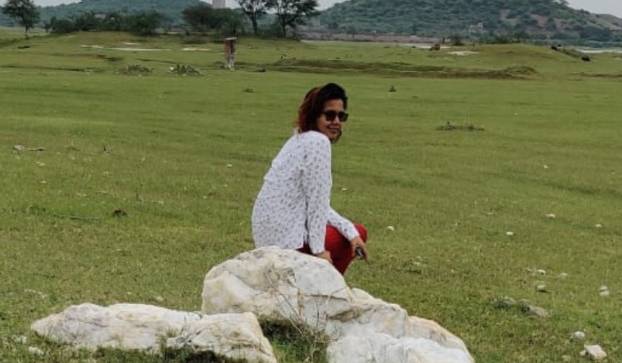

Spotlight: Miss Zarin Ali is an Indian Geologist, Author, Model & Actor. Her work speaks for her exposure to Nature. Her book, “The Story Of Dots” got a lot of traffic in different parts of the world. Her interest in science has been growing ever since. Recently, her actions of science outreach programmes through storytelling has created a new buzz, attracting a lot of media attention. She is surely one of the Indian women in STEM who should be checked out for her love of the science-based art of storytelling. It is a matter of pride to have our social media personalities flooding their ideas of science.
Presenting a glimpse of her latest science fiction from her blog The Vibes. It has been reproduced here as a part of the collaboration for science outreach.
“At the interface of air above and the bedrock below, there lies the plane on which you stand. Some call it the soil and a few merely call it the ground. Is the soil layer, a solid, liquid or gas? Is it fluid? It certainly has a liquidity index. You can call it more viscous and it then doesn’t flow much. However, when the water wets it, it forces it to change its behaviour, a little.
On a ground with wet grasses, essentially the park was a green zone surrounded by buildings. It was shining bright in the daylight. It was surrounded by roads. Both the road and the grassy ground had a few things in common. Other than being used for transport & communication, they were underlain by the bedrock below which concealed itself from the light and chose the dark; the subsurface. (Plz note: The light and the dark are just descriptive terms and is not associated with positive or negative, of any kind.)
It’s difficult to look below the ground unless you have carried out an excavation but even the excavation is not possible by simple means as after a few metres depth below the ground, the people above would feel tired and exhausted by the sweat, they would drop all their machines. Another option might be using sensitive instruments to scan the subsurface. However, the results will show disturbance due to noises and capturing the internal beauty within the subsurface would, therefore, not be an easy job.
With all such thoughts, a young girl in her mid-twenties was ready to walk all the way to the entrance to catch a vehicle that will get her to reach the office. In the middle of her brief journey to the office, she felt something strange as she felt that the plane ground tried to tell something. She was walking on the grassy green park when she saw that the ground rippled with the soil in it. It looked like the ripples that form in general like the current ripple with a stoss and a lee side. The ripples in the ground seemed to travel in a direction opposite to her movement towards the gate. As she walked by the road, she saw some cracks and the peculiarity was in terms of its frequency and pattern of occurrence. It looked somewhat linear and transected by two near perpendicular small cracks propagating opposite to each other and displaced by a half to one metre approx. This pattern was almost occurring many times with the only difference being in the scale of the occurrence. As her route was nearly half (or a bit less than half) of the entire periphery of her living area, the direction of the movement is more strengthened by the occurrence of the ripple in the park. As stoss & lee had geometry, it was more enriching in terms of giving a direction of the movement. The question was – what made to move it? If the agent behind its movement is the same as that responsible for the formation of cracks with a pattern of its appearance, then something must have been in the subsurface. It must have been at a depth that is capable enough to cause the movement of the soil in the park as a ripple, if not the road.
As the area, she was staying in was close to a mining area, possibilities of underground explosions in U/G mining is still not capable to create an almost identical pattern of cracks that she found while walking by the road. She thought that something in the subsurface must have been strong enough that tried to flow below the ground in a direction opposite to her movement till her residential gate. Thus, she sketched an unknown material flowing beneath the ground from the gate to the park with the evidence she found. The area was hit by a cyclone, a few days back but if it had caused the ripples to form (as seen with the soil ground in the park), then the justification of the similar crack pattern on roads becomes mysterious. Moreover, cyclones are strong enough to create ripples on the entire ground but they were just restricted to a small part of the park. This made her think of the subsurface.
It’s quite unlikely that magma from deep sources will try to uprise. If the ground is sagging slowly, it might be a possible reason for the cracks to shows top like that but it won’t be possible until the intensity is the same below all the cracked roads. The more justifiable reason lies in the thought based on the evidence of the ripples that gave a direction.
The girl believed that the subsurface had something to do with it but the peculiarly cracked road might have then been touched. There’s another peculiarity in the time of occurrence of the cracks and the ripples. As a regular observer, the girl never saw the ripply ground but the road cracks had stayed for a long time. If the direction which she thought was wrong, then perhaps something in the subsurface must have taken U-turns in its movement below.
The something below the ground has not yet been solved. Did the ground want to tell something?
Mercy to humanity is everywhere. “
At the end of the story, she asks people to think and answer questions on zombie fires. Is this what the girl in the story was thinking about? It would be creepy to have a fiery, fiery body impregnated in the subsurface because neither Nature nor humans would like to have outbreaks of fires from summer to spring. Zarin says in her blog, “The fires are overshadowed by the snow but the correlation of the burn scars as per some satellite images, show the recurrence of the fires leading to the burning of croplands, quite often. It is zombie type because of its smoky appearance instead of the direct flame front or in simpler terms, the overwintering fires.”
Her statement enlightens us into thinking of the new scientific happenings around. The ending is truly appreciable as it introduces insights on zombie fires that keep occurring anomalously with seasonal fluctuations, some of which might be driven by climate changes.
You can hear more from Zarin Ali by reaching her on Instagram, Twitter & Facebook! We wish Zarin all the best for all her future endeavours.